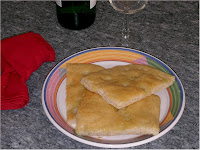
 A version of "slow" the classic Genoese focaccia. If you do not hurry, its long gestation period of the mix will give your cake a better large bubbles, digestibility, time and smell wonderful!
Preparation time 1 hour, plus 12 hours for rising
 | Hard |
Ingredienti
1Kg farina 0 o 00 di media forza (vedi note)
oppure
700 gr di farina 00
300 gr di farina Manitoba
600 ml acqua
oppure
400 ml di acqua
200 ml di vino bianco secco
75 ml di olio
in estate (T.amb. ~ 24-28°C)
1 gr di lievito di birra
in inverno (T.amb. ~ 19-23°C)
2 gr di lievito di birra
3 cucchiaini (15 ml) di sale
2 cucchiai (30 ml) di malto d'orzo in pasta
olio di oliva per emulsione ed ungere q.b.
Preparation
Pay attention primarily to water temperature, ingredients and the environment: in particular, the water must be cold (4 ° C) in summer, cold (10 °) in winter (even wine, if it is used, it must be the same temperature).
To assess whether the temperature is correct, you can use the "rule of 55" means the sum of the temperature of the ingredients, water and environment should be as close as possible to 55.
Knead in mixer for PD or 30 ', adding salt when the dough is already beginning to be together.
The PD can only be used if your model is not one which preheat the basket during the dough, otherwise it defeats the temperature control of the ingredients.
At the end of the dough, this will be very soft, and probably a bit 'sticky. Overthrow on floured pastry board with floured hands too, form a ball and place in a floured bowl.
Cover with a cloth and put to rest at room temperature for 3 hours.
transfer it again on a work surface and divide it into as many parts as are pans that will be fired (allow 350 to 400 gr. Saucepan of pasta for a 35x25).
gently tucking the dough from the bottom, form loaves, flour and let rise covered by a cloth for 2 hours and 1 / 2 at room temperature.
Grease pans thoroughly with 2 tablespoons of oil. The pans are most suitable for tinplate cans, are fine even nonstick aluminum or the classic pizza.
Spread the dough (not remix) with your hands and on the sideboard, then grease the pan, shiacciando strong with your fingertips to form the characteristic "dimple". The dough should have a thickness of about half a centimeter.
Cover with a cloth and let rise for another 6 hours.
Preheat the oven (not ventilated) at 220 degrees, place a cup with water in a corner of the oven. Before
inform abundance as a spray the surface with an emulsion composed of equal parts of olive oil and water with a pinch of salt (hint: put it all into a bottle and shake hard).
After 10 minutes, spray the surface again with the emulsion.
Bake for 10 to 15 minutes, the surface should form a nice golden crust, if you can turn on the grill in the last minute.
fresh from the oven, brush with oil around the surface.
versions most common (and best!):
with sage, finely chopped 3-4 fresh sage leaves and add to mixture.
with chopped onion
a julienne 2-3 cipolle e fatele rinvenire in un filo d'olio, poi bagnate con vino bianco. Portate le cipolle a metà cottura. Spargetele generosamente sulla focaccia prima di infornare. Nota: in questo modo la focaccia risulterà in generale meno cotta.
Con le olive (purpe)
tritate grossolanamente 3-4 cucchiai di olive taggiasche (o altro tipo) e aggiungetele all'impasto. Nota: anticamente si usavano i residui della spremitura delle olive, soprattutto nel levante ligure.
Immagini
Note
La principale difficoltà della ricetta consiste nella manipolazione dell'impasto. To incorporate the flour should be avoided even if the dough is very sticky, but always work with well-floured work surface and hands.
You should also avoid bending on itself or remix the dough, not to "dismantle" and lose more large bubbles rising from a long time.
For a rising of this life, it is essential that the flour has enough "power", ie ability to develop gluten.
The "strength" of the flour is measured by a value called "index W". Unfortunately, this index is not usually indicated on the packaging, but you may be able to find the index "W" of the flour that is usually used with research on the Net
The recommended value for this formula is W = 240 at least. Flour mentioned as specific "pizza" are usually suitable for a long rising. If you can not get a 0 or 00 flour that has the "force" adequate, can be mixed in proportion 70% - 30% flour and 00 Manitoba commercially available. The addition of Manitoba (which has a high index W, 300 or higher) will create a mix with the "strength" required.
Other recipes
There may also be of interest:
| |


0 comments:
Post a Comment